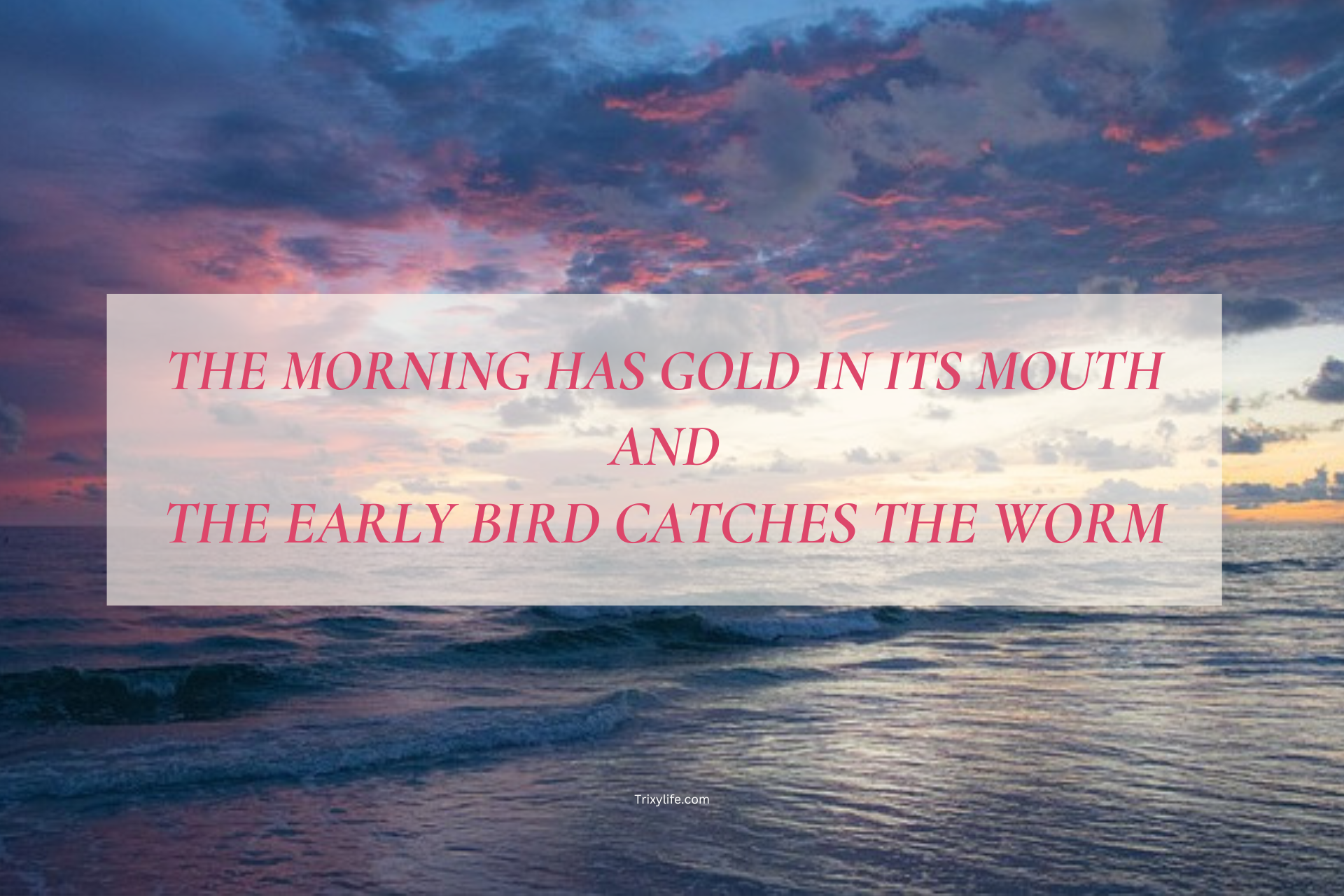
There is something timeless about proverbs. They condense wisdom into just a few words, passed down through generations, often reflecting the values and priorities of the culture they come from. One of my favorite Italian sayings is “Il mattino ha l’oro in bocca” – the morning has gold in its mouth.
I have always loved this proverb. It captures the essence of mornings as a time of opportunity, full of potential waiting to be tapped. Interestingly, there is an English equivalent: “The early bird catches the worm” – l’uccello mattiniero prende il verme.
While both encourage rising early, they do so in ways that reveal subtle cultural differences – differences I find fascinating, especially as someone who has lived between Italian, English, and American cultures.
Italian gold versus English worms
Let’s begin with the Italian version, “Il mattino ha l’oro in bocca.” This saying is a poetic reminder of the value of mornings. The imagery of gold suggests that mornings are precious and brimming with possibilities. It highlights the importance of taking advantage of the stillness and clarity of the early hours.
The English version, “The early bird catches the worm,” offers a slightly different perspective. It is more focused on action, on being the first to seize an opportunity before others have the chance. There is an underlying tone of competition – wake up early, or you might miss out.
Both proverbs share the same fundamental message: mornings are valuable, and starting early can lead to success. But they approach the idea differently. The Italian saying feels more reflective, almost meditative, while the English one is direct and results-driven.
I find myself drawn to both, but the Italian version resonates more deeply with how I view mornings – not just as a time to accomplish tasks, but as a moment to find balance and set the tone for the day.

Why mornings matter to me
I have always been a morning person. Even as a child, I loved waking up early. There was something magical about those quiet moments when the world was still asleep, and the day felt full of potential. That love for mornings has carried me into adulthood, where they have become my most cherished part of the day.
During the week, my alarm goes off at 6 a.m. so I can take Marco to school. By the time I am back home, it is around 7 a.m. For many, this would be the perfect time to crawl back into bed, but I never do. Those early hours are my time – to plan, think, and begin the day with intention.
My mornings aren’t just about ticking items off a to-do list. They are about finding a rhythm, setting small goals, and starting the day with a sense of purpose. Whether I am tackling housework, writing for my blog, or just enjoying a peaceful cup of coffee, I feel calmer and more grounded when I begin early.
The weekend shift
Weekends, however, have always been a bit different. I have allowed myself the luxury of staying in bed a little longer, waking naturally around 7 a.m. and lounging until Pietro gets up at 9. I’d scroll through my phone, read the news, or simply enjoy the slow start.
But lately, I have noticed something. While those lazy weekend mornings feel indulgent in the moment, they often leave me feeling restless later in the day. Even if I manage to accomplish everything on my list, there is this nagging sense of having wasted time.
Last Saturday was a turning point. I stayed in bed until 9, as usual, but by the afternoon, I felt unsettled. I couldn’t shake the feeling that I’d thrown away two valuable hours. It wasn’t just about productivity – it was about the mental clarity I got from starting my day early. Those two hours could have been spent walking, writing, or doing something that brings me joy.

A new commitment
That restless Saturday made me realize how much better I feel when I stick to my weekday routine, even on weekends. So, I have decided to set my alarm for 7 a.m. every weekend. It is a small shift, but one that aligns with my values and goals.
Consistency is key for me. I thrive on routines, and once I establish a habit, it becomes second nature. The first day is always the hardest, but the rewards of sticking with it are worth it.
When I think about what I gain by waking up early, it’s not just about the immediate benefits. There is also a long-term perspective. By setting my alarm two hours earlier on weekends, I gain roughly 8 extra hours of productive time each month. That’s 104 hours in a year – over four full days!
What could I do with four extra days each year? Plenty. I could spend that time reading, writing, going for walks, or even exploring a new hobby. It is a reminder that small changes can have a big impact when viewed over time.
Related posts:
- 10 Life-changing benefits of walking up early (and how you can do it too)
- Procrastination: why do we all do it?
- The perfect cozy fall morning routine
Finding your “why”
Of course, staying in bed is tempting. It is cozy, it is easy, and let’s be honest, sometimes it feels well-deserved. But knowing your “why” can make all the difference.
My “why” is clear: less anxiety and more time for the things I love. By starting my day early, I set the tone for everything that follows.
But it is not just about productivity. It is also about presence. The quiet of the morning lets me reflect, recharge, and reconnect with myself before the chaos of the day begins.

Finding the balance
Both “Il mattino ha l’oro in bocca” and “The early bird catches the worm” remind us of the value of mornings, but I have learned that it is not just about being productive. For me, it is about balance.
Mornings give me the chance to focus on peace before the day gets busy. When I start early, I feel less rushed and more in control. It is not about racing to catch the worm, but about embracing the quiet richness of the morning, the “gold” it offers.
That said, I understand that not everyone is a morning person. Pietro, for example, is the opposite of me. He is a night owl, staying up late and waking up just in time to start the day. And that works for him. He is productive and focused at night in a way I’ll never be.
But for me, the stillness of the morning is irreplaceable. It is when I feel most aligned with myself, when I can think clearly and set the tone for the day ahead.
What mornings mean
At its core, the idea behind “Il mattino ha l’oro in bocca” and “The early bird catches the worm” is about making the most of the time you’re given. Whether you see mornings as golden or as a race to catch the worm, the message is clear: don’t let the day slip away without taking a step toward what matters most to you.
This post isn’t just about mornings; it is about the power of small habits to transform your life. Whether it is waking up earlier, staying up later, or finding your own rhythm, the key is to know yourself and honor what works for you.
Thank you for spending time with me today!
See you next time.
Valentina






Leave a Reply